

background music for the impact
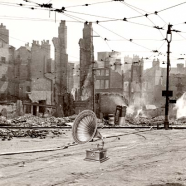
A morning of the wild winter of 1942 a Soviet fighter plane broke the air embargo of the Germans. It flew over the city and plunged to a predetermined point a light sealed zip bag. At the same time all professional musicians who were fighting in the trenches on the outskirts of the city, withdrew from the battlefield. Inside the bag there were the scores from the symphonic work of Dmitri Shostakovich who wrote it (and completed it on 27 December 1941), for the heroism of the besieged (Symphony No7. Op. 60 Leningrad). On August 9 the canons of the beleaguered pounded the German artillery positions, sending more than 3000 shells. German guns fell silent…The Germans were surprised and while they tried to interpret this mass bombing, they heard from every point of the beleaguered city sounds of classical music shaking the air. The Soviets had placed loudspeakers in every street of Leningrad and those residents that could, they gathered and watched this amazing concert. The musicians from the trenches had formed a Symphony Orchestra and played the work of. Shostakovich.
. (http://www.palmografos.com/permalink/11608.html)
In our war no orchestra plays melodies. No epic music reveals the true magnitude of the events, of lives, of the loss, of the conflict between the world falling apart and the one that is being built.. Maybe because in the anecdotal “new world order” of things we are the desubjectified “things”. The Europe of the Enlightenment and the Renaissance, the humanistic Europe, the one we understand as a congenital body as a way to signify life, crumbles with thunder. In its place stands the new suzerain, the homo financius, a derivative of a cultural bubble, a friendly to governability unit, a being who can “function” and “interconnect” in the flat world of globalization, just as this was created by the imaginary of strategists and economic monarchs, without great inspiration, without art, without signification. The Rise of Insignificance (Kornilios Kastoriadis), nourished the sweet monster (Raffaele Simone), and suddenly we found ourselves prisoners of a reality made out of cheap synthetic materials, in the digital theme park of despositifs (Foucault) of our dystopic metropolis.
And that which burdens us, from all around is Kafkaesque, ubiquitous, hidden under tons of inventive legislative seizures of commons, nature, human life. But also deep down under Freudian desires and fixations that torment the poor subjugated and their rulers as in the myth of Erysichthon..
We finished off with the dialects on the Sacred, and that on nature and there came the dialectics onhistory. And it brought with it the terror of the void. And the repression of mortality, to the external fire. so obvious in every tv-ad of shiny dentures…
And amidst the remains of our shattered world (Kornilios Kastoriadis), almost like in determinism, like a natural consequence of all this arrogance, there were the law subsided, where the institutions were raped, there sprung the violence, dressed in a shroud of spells, superstitions and illusions.
“And those who were seen dancing were thought to be insane by those who could not hear the music.” says Nietzsche.
In my own fantasy loudspeakers there are big orchestras playing, deafening silence all around, while I wonder… With what musical armature should I go into the future?
References:
The Rise of the Insignificance – Kornilios Kastoriadis
The sweet monster – Raffaele Simone
dispositif – a term of Michel Foucault
Shattered World – Kornilios Kastoriadis